திருமண முஹூர்த்தம்
திருமண முஹூர்த்தம்
Wedding Muhurtham
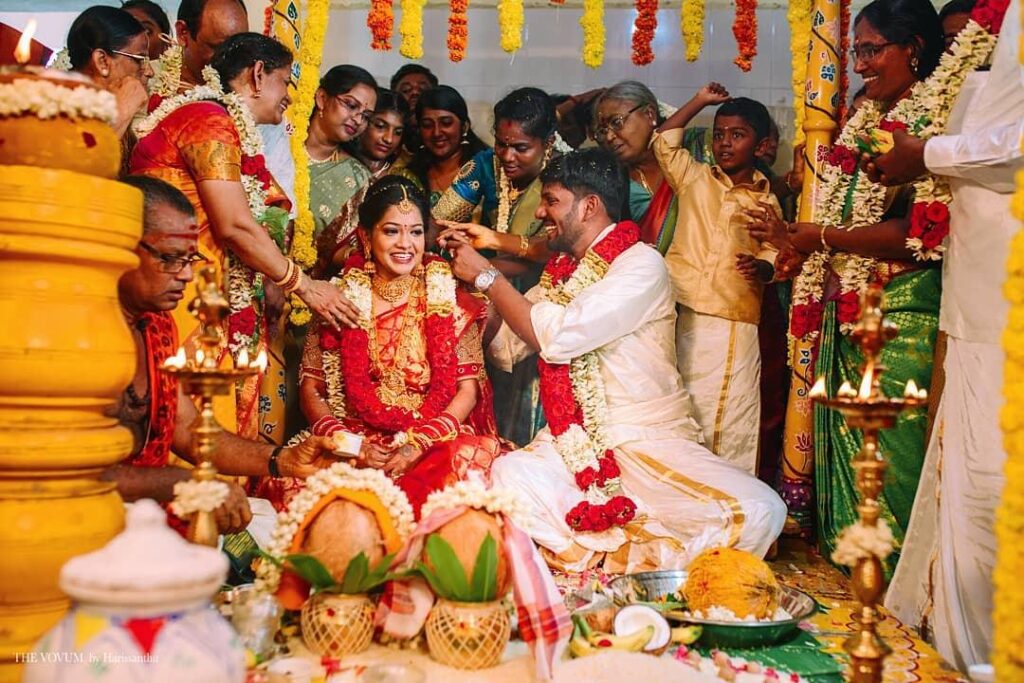
1. Major Wedding Rituals
- Paalikai Niruupanam (“Mulai Paari vithaithal ”)
- Maangalyadhaaranam (Thali Tying Ritual)
- Paanigrahanam(Bride’s hand holding)
- Saptapadi (walking seven steps around the sacred Fire)
1.1 Paalikai Niruupanam (Paalikai Nirupanam)
This is the Tamil wedding ritual commonly known as “Mulai Paari vithaithal ” (placing sprouting seeds).
Meaning of the Terms
- Paalikai: A small earthen pot used during auspicious ceremonies for sprouting nine types of grains (Navadhanyas).
- Niruupanam: Means “confirmation,” “establishment,” or “authentication.”
Description of the Ritual
During the marriage ceremony, in the presence of elders and relatives, different varieties of sprouting seeds are placed in the earthen pots.
Milk-mixed water is sprinkled over the seeds to promote sprouting.
The sprouted seedlings are later planted in the groom’s home garden.
Symbolic Significance
- Represents fertility, prosperity, and growth.
- It is believed to bless the couple with a prosperous and fertile married life.
1.2. Maangalyadhaaranam (Mangalsutra Tying Ritual)
This refers to the ritual where the groom ties the Thali (Mangalsutra) around the bride’s neck.
Meaning
- Maangalyam: Something sacred, auspicious, and blessed.
- Dhaaranam: Act of wearing or adorning.
Key Significance
This is considered the most important ritual in the entire wedding.
A specific auspicious time (Muhurtha Lagna), usually lasting 48 minutes, is strictly observed for performing this ritual.
1.3. Paanigrahanam
This is a Sanskrit term used in weddings, referring to the groom holding the bride’s hand.
Meaning
- “Pani” means hand.
- “Grahanam” means grasping or accepting.
Thus, Paanigrahanam signifies the groom holding the bride’s hand and accepting her as his life partner.
Symbolic Importance
- Represents companionship and responsibility.
- Signifies the beginning of shared duties and mutual support.
1.4. Saptapadi (Seven Steps)
After tying the Thali, the groom and bride walk seven steps around the sacred fire (Agni).
Purpose of the Ritual
The couple takes seven vows, each step representing a core commitment for married life.
Significance
Saptapadi is considered a legally and spiritually binding step in Hindu marriage.
2. How to select Marriage muhurtha?
Marriage muhurtha must satisfy three major purifications:
- Varsha Shuddhi (Annual Purity)
- Graha Shuddhi (Planetary Purity)
- Lagna Shuddhi (Ascendant Purity)
3. Varsha Shuddhi (Annual Purity)
- Bride should get married at an Even number (irataipadai) ages. ( irataipadai vayathu – 22 , 24 , 26 )
- Groom must marry in odd ages. ( ottraipadai vayathu – 25 , 27 , 29 )
- Person Age is calculated from conception date, not from birth date.
- Bride should marry after 3 months from completion of odd age and before 3 months prior to next even age.
- This rules are applicable only if she marries before reaching puberty.
- If age calculation matches for both, it is called Varsha Shuddhi.
4. Graha Shuddhi /(Tri-Pala Shuddhi )
- For a woman, when she enters an Even number (irataipadai) age, the transit Jupiter (Gochara Guru) must be in a favourable position.
- For a man, when he enters an odd age, the Sun Transit (Gochara Surya) must be in a favourable position.
- At the time of marriage, the transit Moon (Gochara Chandra) must be favourable for both the bride and groom.
- Ensuring favourable positions for these three planets (Sun, Moon, Jupiter) is called Tri Bala Shuddhi (Threefold Strength Purification).
4.1 Gochara position of each planet
SUN – Calculated from the Janma Rasi (birth Moon sign)
- Favourable positions: 3, 6, 10, 11
- Positions needing remedies: 1, 2, 5, 7, 9
- Positions to avoid: 4, 8, 12
MOON – Calculated from the Janma Rasi (birth Moon sign)
- Favourable positions: 1, 3, 6, 7, 10, 11
- Positions needing remedies: 2, 5, 9
- Positions to avoid: 4, 8, 12
JUPITER – Calculated from the natal Rasi in the birth chart
- Favourable positions: 2, 5, 7, 9, 11
- Positions needing remedies: 1, 3, 6, 10
- Positions to avoid: 4, 8, 12
Both Varusha Shuddhi (Year-Purification) and Graha Shuddhi (Planetary-Purification) must be present while fixing a marriage.
- If both are present: Extremely auspicious.
- If only Varusha Shuddhi is present: Medium result (moderately favourable).
- If both are absent: Very unfavorable (strongly advised against).
5. Lagna Shuddhi (Ascendant Purity)
- In marriage, the Muhurtha Lagna (Auspicious Ascendant) is extremely important.
It is considered the lifeline of marital life. Ensuring that this ascendant is chosen without any dosha (affliction) is called Lagna Shuddhi. - Karana is more important than Tithi.
- The weekday (Vara) is more important than the Karana.
- The star (Nakshatra) is more important than the weekday.
- The marriage ascendant (Vivaha Lagna) is more important than the Nakshatra.
- While selecting the Lagna in the Rasi chart for marriage, the Navamsa Lagna must also be selected with great care.
5.1 Important Rules for Muhurta lagnam:
- Avoid Masa Shunya Lagna and Tithi Shunya Lagna.
- The birth sign and ascendant of bride and groom should not coincide with the auspicious ascendant of the wedding ceremony.
- Avoid Lagna or Navamsa falling in 4, 8, 12 from their Janma Lagna or Rashi.
- If 8th lord of Rashi or Navamsa is in marriage Lagna, it gives danger to bride.
- Guru in Leo Navamsa (Vargottamam) is not auspicious.
- Marriage Lagna’s Lagna lord and Navamsa lord must not be weak; otherwise causes poverty.
6. Suitable Months for Marriage
6.1.Use Suriya Months only
For determining auspicious marriage months, the calculation must be based on the solar calendar months (Saura Maasa), not the lunar months (Chandra Maasa).
Explanation:
Solar months align with the Sun’s transit (Sankranti to Sankranti). These months are considered more stable and reliable for major life events like marriage.
6.2. Conducting Marriage During Uttarayana Is Highly Auspicious
The Uttarayana period (from Thai month to Aani month) is considered very good for marriage.
However, the Masi month (during Uttarayana) should ideally be avoided.
Explanation:
- Uttarayana represents the Sun’s northward movement, symbolizing growth and positive energy.
- Traditionally, Masi is avoided due to certain astrological and religious beliefs that deem it less favorable for solemn ceremonies.
6.3. Marriages During Dakshinayana
During Dakshinayana (Sun’s southward movement), the months of Aadi, Purattasi, and Margazhi should be avoided.
Marriages can be conducted in all other months of Dakshinayana.
Explanation:
- These three months fall into a spiritually sensitive period due to religious observances and planetary conditions, making them traditionally inauspicious for celebrations.
6.4. Guru (Jupiter) and Shukra (Venus) Should Not Be in Asta (Combustion)
During the selected marriage month, Jupiter or Venus must not be combust by the Sun.
Explanation:
- Venus is the karaka (significator) of marriage.
- Jupiter is the karaka of family, prosperity, and auspiciousness.
- When these planets are in combustion (too close to the Sun), their benefic influence weakens, making it unsuitable for marriage ceremonies.
6.5. Highly Auspicious Marriage Months
- Chithirai
- Vaikasi
- Thai
- Masi (Note: Though Masi has restrictions, astrologically it is still considered a good month when conditions are favorable)
Explanation:
- These months generally carry strong auspicious planetary alignments and cultural significance, making them highly preferred for marriage.
6.6. Moderately Auspicious Months
- Aippasi
- Karthigai
Explanation:
These months are not as strong as the prime auspicious months but are still acceptable for conducting marriages when planetary timings are supportive.
7. Auspicious Nakshatras
- Uttiram, Uttiradam
- Rohini, Hastham, Thiruvonam
- Mrigasīrisham
- Swathi
- Uttirattathi, Anusham
- Revathi
- Magham, Moolam
Avoid:
- First Patham of Magham and Moolam
- Last patham of Revathi
8. Auspicious Tithis
- Prefer Shukla Paksha (waxing moon).
- Avoid : Krishna Paksha moon
- Good: Dwitiya, Tritiya, Panchami, Saptami, Dashami, Ekadasi, Dwadashi, Trayodashi
- Karthigai Pournami is highly auspicious.
- Avoid: Amavasya, Prathamai, Pournami (other months).
Rikta Tithis (Avoid)
4, 8, 9, 14
Krishna Paksha (Avoid)
Ekadasi, Dwadashi, Trayodashi, Chaturdashi, Amavasya
9. Auspicious Karanas
- Bava ,Balava,Kaulava,Taitula ,Garaja ,Vanija
10. Suitable Weekdays
- Monday ,Wednesday,Thursday,Friday
Avoid:
- Tuesday, Saturday ,Sunday
- Exception: Sunday allowed if Sun has benefic aspect.
11. Auspicious Lagnas
- Taurus ,Libra, Gemini, Virgo, Cancer, Leo, Sagittarius, Aquarius
Rule:
Moon sign, Lagna, and Navamsa Lagna must not all be movable signs simultaneously.
21 Maha Doshas in Marriage
- Lack of Panchanga Shuddhi – Marriage conducted without considering auspicious tithi, vara, nakshatra, yoga, and karana causes instability
- Impure Lagna Dosha – A weak or afflicted ascendant negatively affects married life.
- Affected 7th House – Damage to the 7th house leads to marital discord and separation tendencies.
- Affected 8th House – Afflicted 8th house reduces marital longevity and harmony.
- Masa Dosha – Birth in inauspicious months creates obstacles to marriage.
- Papa Shadvarga Dosha – Malefic dominance in divisional charts weakens marriage prospects.
- Venus in 6th House – Causes conflicts, misunderstandings, and lack of marital happiness.
- Mars in 8th House – Creates stress, health issues, and disturbances in married life.
- Gandanta Dosha – Birth in junction nakshatras brings emotional instability in marriage.
- Affected Lagna Lord – Weak ascendant lord reduces personal stability in relationships.
- Affected 7th Lord – Weak marriage lord results in delays or troubled married life.
- Combust Venus – Venus too close to the Sun weakens marital pleasure and harmony.
- Retrograde Venus – Indicates delays and confusion in marital relationships.
- Malefic Aspect on 7th House – Causes continuous interference and misunderstandings between life partners.
- Rahu–Ketu Affliction – Creates unconventional issues and instability in marriage.
- Kuja (Mars) Dosha – Mars affliction causes aggression and disharmony between spouses.
- Nadi Dosha – Indicates health and progeny-related problems after marriage.
- Rasi Dosha – Moon sign mismatch between bride and grooms.
- Rajju Dosha – Indicates risk of separation or physical distance between spouses.
- Yoni Dosha – Sexual incompatibility and lack of mutual attraction.
- Same Nakshatra Dosha – Same star births cause ego clashes and reduced longevity of relationship.